How do I make a thesis defense presentation with AI?
Updated 2026-11-07
A thesis defense deck is usually one to two minutes per slide: about 10 to 15 slides for a 15-minute talk and 15 to 25 for 30 minutes, plus a few backup slides you do not present. Each slide carries one step of the argument: why the question matters, what you did, what you found, what it means. Check the length and format your department sets before you count slides.
To build it with Gamma AI Slide, attach your thesis (Word .docx, or a PDF with selectable text), write the talk length and the slides you want, check the outline cards, and generate. You get an editable PowerPoint (.pptx). Writing the outline is free; a quick-mode slide is 1 credit, so a 15-slide deck is 15 credits.
What we have and have not done: we have no recorded thesis defense, and the picture below is a different real recording (a course proposal). The structure table and the timings are common practice, not a rule from any university. The product steps and limits come from the interface and the code, read 2026-11-07.
Six steps from thesis to defense deck
Find out what your department requires
Ask for the talk length, how many minutes are kept for questions, whether a university template is mandatory, and whether AI tools may be used for the slides. We cannot know these rules for you, and they override everything on this page.
Prepare a file the AI can read
Word (.docx) works best. A PDF must have selectable text: a scanned PDF where every page is a picture is not read. Each file can be up to 25 MB.
Mark chapter titles with Word’s Heading 1 and Heading 2 styles, not just bold big text. Word headings (and PDF bookmarks) are read as a table of contents, which matters for a long thesis (see the question on long documents below).
Write the request and attach the file
On the home page, click "Add files", add the thesis, and paste the request below with your numbers. Click "Next". Choose "Quick mode" (1 credit per slide) unless you want the AI to design each slide freely (deep mode, 3 credits per slide).
Check the outline against the structure table
The outline has one card per slide. Under "More", set the scenario to "Talk" and the tone to "Rigorous". "Text per slide" is best at "Concise": a defense slide is read in seconds. There is no committee audience in the list, so leave the audience on "Auto" and say who is in the room in the request.
Compare the cards with the table on this page: a results slide per finding, one limitations slide, one conclusion slide. For a table of results pick the layout "Table" on its card; for steps of a method pick "Steps". A card that states a figure your thesis does not contain says "Not in your materials: … It will be written as TBD". Nothing is charged until you click "Generate presentation".
Generate, then check every number against the paper
Click "Generate presentation". Open the export panel: it shows "x / y figures have a source" and lists the figures that have none. Check each result, sample size and p-value against your thesis yourself: the checker tells you where a figure came from, not whether your analysis is right.
Export, add notes and rehearse with a timer
Click "Export" and choose PowerPoint (.pptx) or PDF. Exporting costs no credits, but it needs Level 2 (any credit pack, bought once) or one new person invited per deck. The exported PowerPoint has no speaker notes, so write yours in PowerPoint (see the guide on speaker notes). Rehearse aloud with a timer and cut slides until you finish with the questions time intact.
A 15-slide structure with time per section, and a real "problem" slide
This table is our suggested structure for a 20-minute talk (common practice, not a standard). Move the minutes in proportion if your slot is shorter: spend them on results, not on literature.
| # | Slide | What goes on it | Minutes |
|---|---|---|---|
| 1 | Title | Thesis title, your name, supervisor, programme, date | 0.5 |
| 2 | Roadmap | The four parts of the talk in one line each (optional) | 0.5 |
| 3 | Background and problem | Why the question matters, with one or two figures | 2 |
| 4 | Research gap and question | What is not known, and your question(s) in one sentence each | 1.5 |
| 5 | Aims and contributions | What you set out to do and what the thesis adds | 1 |
| 6 | Literature in one slide | The two or three works your study builds on | 1 |
| 7 | Methods | Design, sample or data, procedure | 2 |
| 8 | Data and measures | Variables, instruments, how you checked quality | 1 |
| 9–11 | Results | One finding per slide, one figure or table each | 6 |
| 12 | Discussion | What the results mean, against the literature | 2 |
| 13 | Limitations | What the study cannot show, said before the committee asks | 1 |
| 14 | Conclusion and implications | Answer to each question, one line each | 1 |
| 15 | Future work and thanks | Next step, acknowledgements, "Questions?" | 0.5 |
Backup slides (after "Questions?") hold extra tables, robustness checks and the detail of the method. Keep them out of the timed count. The picture is slide 2 of 10 in our recorded course proposal (Data Literacy 101, 2026-10-20, deep mode): three numbered points and a boxed side note about the scope. It is not a thesis. It shows how a background-and-problem slide comes out: a claim as the title and three short points, not a paragraph.
Prompt (English)
Thesis defense, 15 slides, 20 minutes
Using the attached thesis, make a 15-slide defense presentation for a 20-minute talk to my examination committee. Follow this order: title; roadmap; background and problem; research gap and question; aims and contributions; literature in one slide; methods; data and measures; three results slides (one finding each, with the figure or table from the thesis); discussion; limitations; conclusion and implications; future work and thanks. Use only facts and figures from the thesis: write TBD where a figure is missing. Keep slide text short, with a claim as each slide title.
(Replace the numbers with your own. Name your three main findings in the request so the three results slides match your thesis.)
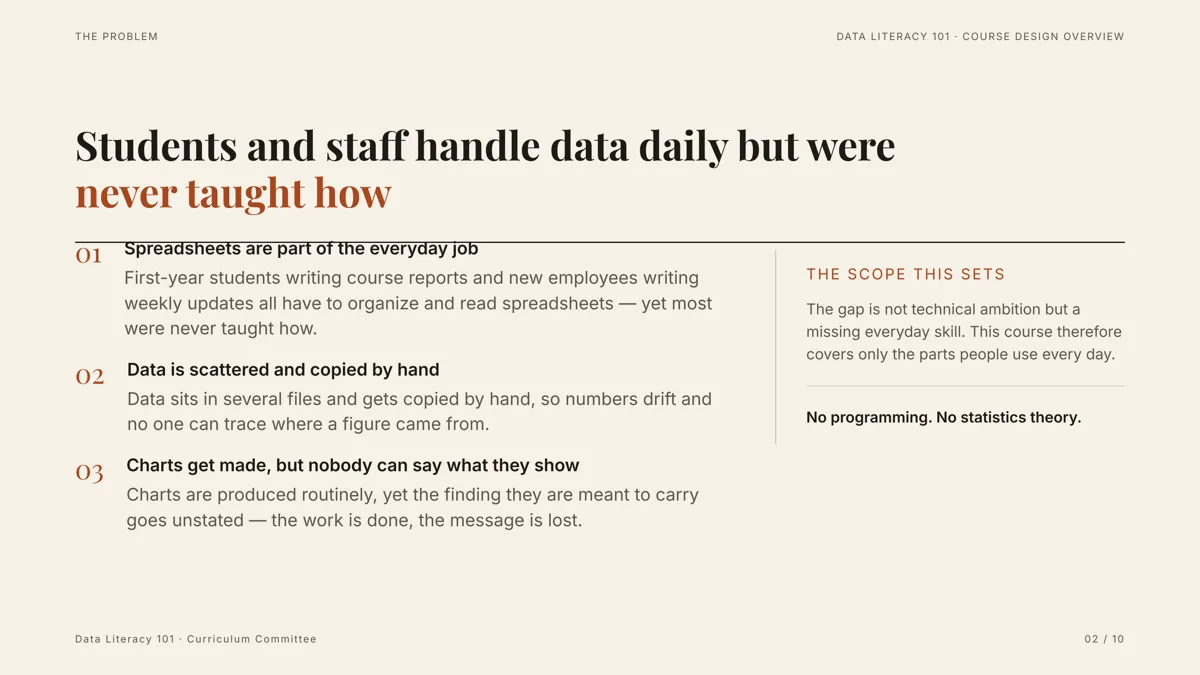
- The title states the claim, so the committee can follow the argument from the titles alone. Use the same habit for your background, gap and discussion slides.
- Three short numbered points replace a paragraph; the side box is where "the scope this sets" goes, which in a thesis is your research question or its limits.
- This slide came from a draft the request attached, so its facts come from that file. For your thesis the same holds: the more of the content is in the file, the less the AI has to guess.
- Replay this run step by step (no sign-in)
- Download the PPTX
- Research paper to academic presentation
- Presentations for students: coursework, projects and reports
- How many slides for a talk length
- Speaker notes: what the export has and does not have
- Thesis defense guide in Simplified Chinese
- Thesis defense guide in Russian
How many slides should a thesis defense have?
Count one to two minutes per slide and keep the question time out of the talk. This is a rule of thumb, not a standard; the product accepts 1 to 30 slides and the cover counts.
| Talk length | Slides to present | Backup slides |
|---|---|---|
| 10 minutes | 5 to 10 | 2 to 4 |
| 15 minutes | 8 to 15 | 3 to 5 |
| 20 minutes | 10 to 20 | 3 to 6 |
| 30 minutes | 15 to 25 | 4 to 8 |
Dense results slides take longer than title slides, so stay at the lower end if your results are heavy. The backup column is our suggestion.
What goes on each slide, and what stays out?
Put on a slide what you will say in about a minute, and leave the rest in the thesis:
- One message per slide, written as the title.
- One figure or table per results slide, redrawn large; copy no paragraph from the thesis.
- Keep the literature to one slide: the committee has read your literature chapter.
- Name the limitations yourself. A limitations slide you present takes away the committee’s easiest question.
- Leave out the acknowledgements’ long list, the full reference list and every robustness table: put them in backup.
How does the product handle a long thesis?
It reads only part of a long file at a time, and it says so. When the outline is written, all your files together get about 24,000 characters (roughly the first 4,000 words, our approximation). A long file is read as its table of contents first, from Word headings and PDF bookmarks, then its opening. Each slide it later makes reads whole paragraphs and tables from your files that match that slide’s card, up to about 14,000 characters.
Text you type in the request box is read up to the first 8,000 characters when the outline is written. So for a full thesis:
- Use Heading styles in Word, so the table of contents is real.
- Name the three findings and the research question in the request, so the cards for them exist.
- Or attach a short file instead: abstract, research questions, method summary, the results chapters, conclusion. A defense deck does not need the whole thesis.
The outline page’s sources panel says which files were too long to read whole.
How do I prepare for the committee’s questions?
The product does not predict questions; this is a practical checklist.
| Question the committee often asks | Where the answer lives in your deck |
|---|---|
| Why this question, and why now? | Background and gap slides (3–4) |
| Why this method and not another? | Methods slide, plus a backup slide on the alternatives you rejected |
| How do you know the result is not an artefact? | Backup: robustness checks, sample details |
| What are the limits of your study? | Limitations slide (13) |
| What would you do next? | Future work slide (15) |
Write each answer as a two-sentence note and add it to the backup slide it points to. You can also ask the AI assistant in the editor to add a backup slide ("Add a slide after slide 15": a table of the robustness checks), 1 credit; check its figures against your thesis.
Is it allowed to use AI for the defense slides?
That is your institution’s rule, not ours. Some departments require you to disclose AI tools and some restrict them. Ask before you use it, and keep the facts, the figures and the argument your own: the AI drafts the slides from your file, and you are the one defending them.
Questions
How many slides should a thesis defense presentation have?
About one to two minutes per slide: 10 to 15 slides for a 15-minute talk and 15 to 25 for 30 minutes, plus backup slides you do not present. Your department’s rules come first.
How do I make a thesis defense presentation from my paper?
Attach your thesis (Word or a PDF with selectable text) on the home page, write the talk length and the slide order, check the outline cards, generate, and export an editable PowerPoint. Then check every number against the thesis and rehearse with a timer.
What should a thesis defense presentation include?
Title, background and problem, research gap and question, aims and contributions, a one-slide literature summary, methods, data, one slide per main result, discussion, limitations, conclusion, and future work. Put extra tables in backup slides.
Can it read a very long thesis?
Partly. The outline reads about 24,000 characters across all files, using the table of contents for a long file, and each slide reads the passages that match its card. Use heading styles, or attach a shorter file with the abstract and results chapters.
Will the AI invent results or numbers?
If your attached file contains figures, a figure that the file lacks is written as TBD instead of an invented number, and the export panel lists figures without a source. Figures typed only in the request do not switch that rule on, so check them yourself.
Does the PowerPoint include speaker notes?
No. The exported PPTX has text, shapes and tables you can edit, but no speaker notes; write your own in PowerPoint.
How much does it cost?
Writing the outline is free. Quick mode costs 1 credit per slide, deep mode 3, each AI edit 1. Exporting costs no credits, but it needs Level 2 (any credit pack, bought once) or one new person invited per deck. New accounts get 20 free credits; credit packs are one-time purchases with no subscription, and credits never expire. See the Pricing page for the packs.
Are my files used to train AI models?
No. We do not use your files to train AI models. The text of your files is sent to AI providers to write the outline and slides; the Privacy Policy has the details.
Start from your thesis
Attach the Word file, write the talk length, and see the 15 outline cards, and which figures are marked TBD, before any slide is made.
Make my defense deck